
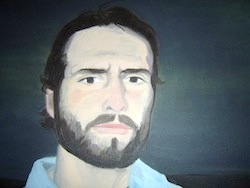
Portrait by Elizabeth Ross (2005).
Matt Hunter Ross
Fine artist – designer, animator, illustrator and author.
Owner and director at FESTHAUS.
Author and illustrator at MATTRHORNS.
Based in Cincinnati, Ohio.
–
Education
MFA, Motion Media – Savannah College of Art & Design, Savannah, Georgia.
BFA, Fine Art & Architectural History – Ohio University, Athens, Ohio.
–
About
I am formally educated in classical fine arts and digital media.
Like all artists, your artwork is informed by your experiences – in my case, this is a fusion of professional stints in illustration and animation, but also reflects my upbringing in and fondness of the classical, tactile studio arts and music. My parents were both classically-trained musicians (mother – fine artist, pianist and vocalist (CCM, May Festival, et al), and father – pianist and organist), and I in low brass (tuba) and woodwinds (alto sax). Extended family were naturalists and friends of artists and collected fine art, such as numerous works by Edward Volkert as well as Native American collections. The classics reflect a nostalgic nature that runs in my family, though I also consider myself in many ways an optimistic futurist (through a modernist lens).
Aesthetically, I prefer looser, organic brushwork, layering scenes quickly, and so lean toward quicker drying media. Linework plays heavily in my thinking about rendering a subject, and flat planes and solid, bold colors that hint at its background details and surroundings rather than explicitly define them. Combining both clefs – lines as treble, solids as bass – to tell a story.
My preferred subject matter is historical modernism, science and naturalism – and of course, beauty.
A long time ago I thought I would be an architect, bettering society through the art of the brick, a la the great, iconic architectural designers of modernist era. I once considered school at Taliesin West, building to the environment rather than over it, and historic preservation and sustainability at Tulane – helping structures partner with the natural world rather than steamrolling it.
Today, in my love for my wife (a naturalist and nature artist) and children (emerging artists in their own right) and all other things beautiful, my preference has shifted toward an “organic architecture” – the structure of the natural world (and the humanity of built structures within it) – rather than the formal built environment per se. I still love architectural design and human-made environments, but am now more interested in the things that give them life – the landscape around them, the people within them, and the natural growth and weathering and disarray that develops from them both over time. The real beauty is in that life. Thus, I no longer have interest in realistically rendering static subjects and making things look perfect – perfection is perception which is subjective and thus does not exist, only the movement and passage of time and the change that results from it is. Perception is reality, and change is the only constant.
Scientifically, I like the hidden world of natural design, either through macro or micro lenses.
Historical preferences also come into play, as my grandparents on both sides (and further lineage) reflected sentimental attitudes toward and personal experiences with native, indigenous American people and cultures. Collections of handmade textiles and other objects passed down fill our house, subtly but continually reminding us of past civilizations through bold colors and geometric patterns and textures.
I love this intersection between modernist aesthetics (throughout the design world of that era) and historical indigenous design – a purity with depth and meaning hidden in its simplicity, that has longevity which transcends eras. Looking to the future by reflecting the past – that is my design intent.